Naive Bayes Classifer
Definition
Naive Bayes classifiers are based on naive bayes classifier algorithms. Let’s say we have m input values
- Assume all these input variables/features are conditionally independent given Y and equally contributed to the outcome.
In reality it is not quitepossiblethat all features are conditionally independent
- Simply chose the class label that is the most likely given the data, predict Y using
Bayes’ Theorem
Bayes’ Theorem gives the probability of an event occurring given the probability of another event that has already occurred.
where y is class variable and is a feature vector where
-
basically, we are trying to find probability of event y, given event x, event x is also termed as evidence.
-
p(x) is prior probability of x and p(y) is prior probability of y.
-
is a posteriori probability of y.
Since given assumption that all features are independent, then
As the denomitor remains constant for a given input, we can obtain equations like follows:
To maximize the probability of event y given the probability of event x is the same as to choose/calculate parameter y which result maximal probability using MAP:
Compare between MLE and MAP
- the key part difference is that prior distribution of unknown parameter is known or not, or is uniform or not.
Details can be found here:
Example
| Outlook | Temperature | Humidity | Windy | Play Golf |
|---|---|---|---|---|
| Rainy | Hot | High | False | No |
| Rainy | Hot | High | True | No |
| Overcast | Hot | High | False | Yes |
| Sunny | Mild | High | False | Yes |
| Sunny | Cool | Normal | False | Yes |
| Sunny | Cool | Normal | True | No |
| Overcast | Cool | Normal | True | Yes |
| Rainy | Mild | High | False | No |
| Rainy | Cool | Normal | False | Yes |
| Sunny | Mild | Normal | False | Yes |
| Rainy | Mild | Normal | True | Yes |
| Overcast | Mild | High | True | Yes |
| Overcast | Hot | Normal | False | Yes |
| Sunny | Mild | High | True | No |
Task: estimate whether or not to play golf when it’s {Rainy, Hot, High, False}
Solution:
Given specific observations mentioned in the task:
Now after normalization or logarithmic calculation, we compare both probabilities for playing gold and not playing gold, and the prediction would be the one with higher probability:
Implementation continuous data model from scratch
Import module
import numpy as np
from sklearn.model_selection import train_test_split
from sklearn import datasets
import matplotlib.pyplot as plt
Input datasets
X, y = datasets.make_classification(n_samples=1000, n_features=10, n_classes=2, random_state=123)
X_train, X_test, y_train, y_test = train_test_split(X,y,test_size=0.2,random_state=123)
print(X.shape)
print(y.shape)
print(X[0:5])
print(y[0:10])
(1000, 10)
(1000,)
[[ 0.24063119 -0.07970884 -0.05313268  0.09263489 -0.13935777  1.20319285
  -0.15590018 -0.09709308  0.06994683  0.11660277]
 [ 0.75425016 -0.937854    0.21947276 -1.28066902  1.55618457 -0.65538962
   0.77023157  0.19311463 -2.27886416  0.65102942]
 [ 0.9584009  -1.31841143  1.15350536 -0.96816469  1.88667929  0.53473693
   0.46015911  0.0423321   0.79249125  0.24144309]
 [ 0.64384845  0.35082051 -0.10869679  0.71060146 -0.85406842  0.33485545
   0.60778386  0.94834854  1.29778445  2.16583174]
 [ 1.03268464 -1.26482413  0.18067775  0.35989813 -0.26303363 -0.33760592
   0.52075594 -1.4403634   1.25766489  0.14630826]]
[0 0 1 1 1 0 0 0 1 0]
create naive bayes model
class NaiveBayes:
    def fit(self, X, y):
        self._samples, self._features = X.shape
        self._classes = np.unique(y)
        self._labels = len(self._classes)

        # initialize mean, var, and prior for each feature
        self._mean = np.zeros((self._labels, self._features), dtype=np.float64)
        self._var = np.zeros((self._labels, self._features), dtype=np.float64)
        self._priors = np.zeros(self._labels, dtype=np.float64)

        # calculate mean, var and prior for each feature given y
        for i,label in enumerate(self._classes):
            temp = X[y==label]
            self._mean[i,:] = temp.mean(axis=0)
            self._var[i,:] = temp.var(axis=0)
            self._priors[i] = temp.shape[0]/float(self._samples)

    # calculate posterior for each class given observed dataset x
    def _train(self, x):
        posteriors = []

        for i, label in enumerate(self._classes):
            prior = np.log(self._priors[i])
            posterior = prior + np.sum(np.log(self._pdf(i,x)))
            posteriors.append(posterior)

        # compare and return highest posterior probability
        return self._classes[np.argmax(posteriors)]


    # calculate pdf for each row of observed dataset x
    def _pdf(self, index, x):
        mean = self._mean[index]
        var = self._var[index]
        numerator = np.exp(-(x-mean)**2 / (2*var))
        denominator = np.sqrt(2*np.pi*var)
        return numerator/denominator

    # predict test data
    def predict(self, X):
        y_pred = [self._train(x) for x in X]
        return np.array(y_pred)

    # calculate accuracy
    def accuracy(self, y_test, y_pred):
        accuracy = np.sum(y_test == y_pred) / len(y_test)
        return accuracy
nb = NaiveBayes()
nb.fit(X_train, y_train)
print(nb._classes)
print(nb._samples)
print(nb._features)
print(nb._labels)
print(nb._mean.shape)
print(nb._var)
print(nb._priors.shape)
print(nb._pdf(0,X[0]).shape)
y_pred = nb.predict(X_test)
print(nb.accuracy(y_test,y_pred))
[0 1]
800
10
2
(2, 10)
[[0.98269025 0.95576451 0.36205835 0.44312622 1.29896635 0.86864312
  1.03288266 0.89110435 0.33131845 0.95275246]
 [1.03305993 0.95375061 0.48209481 0.59179712 1.7236553  0.92576642
  0.96969459 1.10314154 0.50775021 1.14787765]]
(2,)
(10,)
0.965
nb = NaiveBayes()
nb.fit(X_train, y_train)
y_pred = nb.predict(X_test)
accuracy = nb.accuracy(y_test,y_pred)

print("Naive Bayes classification accuracy", accuracy)
Naive Bayes classification accuracy 0.965
Implementation using sklearn
import modules
import numpy as np
import pandas as pd
import matplotlib.pyplot as plt
import seaborn as sns
from sklearn.model_selection import train_test_split
from sklearn import datasets
import datasets
X, y = datasets.make_classification(n_samples=1000, n_features=10, n_classes=2, random_state=123)
X_train, X_test, y_train, y_test = train_test_split(X, y, test_size=0.2, random_state=123)
Model Training
from sklearn.naive_bayes import GaussianNB

nb = GaussianNB()
nb.fit(X_train, y_train)
GaussianNB()
Predict the results
y_pred = nb.predict(X_test)
y_pred.shape
(200,)
from sklearn.metrics import accuracy_score

print('Model accuracy score: {0:0.4f}'. format(accuracy_score(y_test, y_pred)))
Model accuracy score: 0.9650
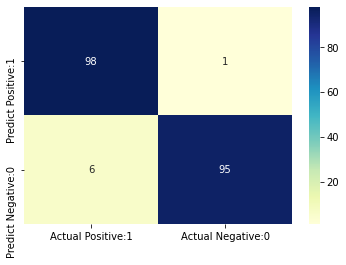
Confusion Matrix
from sklearn.metrics import confusion_matrix

confusion_matrix = confusion_matrix(y_test, y_pred)
print('Confusion matrix\n\n', confusion_matrix)
Confusion matrix

 [[98  1]
 [ 6 95]]
Visualize confusion matrix
cm_matrix = pd.DataFrame(data=confusion_matrix, columns=['Actual Positive:1', 'Actual Negative:0'],
                                 index=['Predict Positive:1', 'Predict Negative:0'])

sns.heatmap(cm_matrix, annot=True, fmt='d', cmap='YlGnBu')
<AxesSubplot:>